
Growth creates a people question before it becomes an HR question: how many people will the business need, in which roles, with which skills, and at what cost? Hiring after teams are overloaded can slow delivery. Hiring too early can create unnecessary fixed cost. Workforce Planning helps leaders balance both risks.
For a growing company, Workforce Planning should connect business targets with capacity, organization structure, skills and budgets. Headcount forecasting is one part of that process because it estimates the number and type of employees likely to be required over a defined period.
When the process is done well, leaders can make hiring decisions earlier, identify capability gaps before they affect execution, and avoid treating every vacancy as an automatic replacement.
What Is Workforce Planning?
Workforce Planning is the process of understanding the people and capabilities a business has today, estimating what it will need in the future, and closing the gap in a financially sensible way.
It should answer practical questions: What growth is expected over the next 12 to 24 months? Which functions will carry that growth? Which roles are close to capacity? Which skills are difficult to hire? Which positions are critical to revenue, quality or continuity? What can be solved through better processes or technology instead of additional hiring?
The broader idea is often called strategic human resource planning.
Wikipedia describes strategic human resource planning
as connecting current and future human-resource needs with organizational goals. That connection matters because headcount decisions should follow strategy, not isolated recruitment requests.
Why Workforce Planning Matters for Growing Companies
Fast-growing businesses often hire reactively. Sales wins more business, operations misses deadlines, managers request people, and HR starts recruitment. By the time the new employee joins, delays and burnout may already have appeared.
Workforce Planning changes the sequence by estimating demand before the shortage becomes urgent. A revenue target may require sales capacity, but it can also increase pressure on quality, finance, supervision and customer service.
Reuters reported in September 2026 that Starbucks planned a global technology centre in Chennai, with access to skilled talent and low attrition among the factors associated with the location. Workforce availability can therefore become a strategic business issue.
Workforce Planning vs Headcount Forecasting
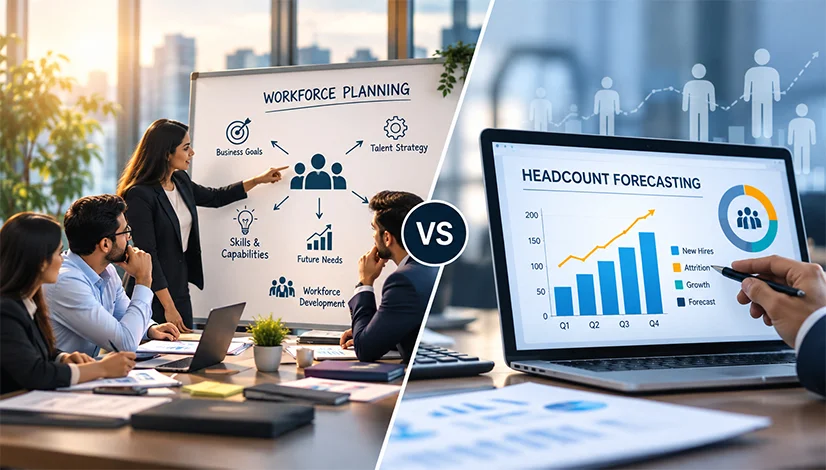
Headcount forecasting estimates how many employees are likely to be required. Workforce Planning is broader. It considers headcount, skills, productivity, internal talent supply, succession, attrition and cost.
A company may forecast 30 additional employees next year. Better planning asks what those people should do, which roles are critical, whether internal employees can be developed, and whether process improvement can reduce the requirement.
Headcount is a number. The broader planning process turns that number into a business decision.
1. Start Workforce Planning With the Business Plan
Do not begin by asking managers, “How many people do you want next year?” Start with projected revenue, production volume, new locations, product launches, major customers, automation projects and cost targets.
Translate each priority into workload and capability implications. A new production line may require operators, maintenance technicians, quality engineers and supervisors. Geographic expansion may require sales capacity before the full support structure.
This makes the approach demand-led rather than opinion-led.
2. Build a Reliable Workforce Planning Baseline
Forecasting is weak when current organization data is unclear. Build a baseline showing approved positions, filled positions, vacancies, contract resources, reporting lines, employee cost, skills, location and critical-role status.
Distinguish between sanctioned and actual headcount. A department may appear understaffed because positions are vacant, while another may be fully staffed but still depend on overtime or rework.
A realistic baseline gives the process a dependable starting point.
3. Use Business Drivers for Headcount Forecasting
Useful forecasts connect employee demand with measurable business drivers. A support team may use ticket volume and average tickets handled per employee. A production team may use units, machine capacity and shifts. A sales team may use territory coverage or expected revenue per salesperson.
Then adjust for seasonality, leave, learning curves, supervisory ratios and technology changes. Workforce Planning should not simply increase last year’s headcount by the same percentage as the revenue target.
4. Forecast Internal Supply in Workforce Planning
Demand tells you what the business needs. Supply tells you what talent is likely to be available. Review expected resignations, retirements, promotions, transfers, development pipelines and roles that may change because of technology.
If a plant needs six supervisors next year and four team leaders can be developed, external recruitment may be needed for only two. Workforce Planning becomes more valuable when leaders see this gap early and can build internal talent before vacancies become urgent.
5. Include Attrition in Workforce Planning
Headcount plans often calculate growth hiring but forget replacement hiring. If a company expects to add 25 roles and also expects 15 employees to leave, recruitment demand may be closer to 40 positions, depending on which exits require replacement.
Use role-specific attrition where possible because a company-wide average can hide large differences between functions. Workforce Planning should also question whether every exit must be replaced or whether work can be redesigned.
6. Identify Critical Roles Through Workforce Planning
Not every vacancy creates the same business risk. A maintenance specialist, plant head, technical expert or key account manager may directly affect revenue, quality, compliance or continuity.
For each critical role, ask whether there is a ready successor, how long external hiring would take, whether knowledge is concentrated in one person, and who can provide temporary coverage.
This connects the plan with succession planning and business continuity.
7. Build Skills Into Workforce Planning
Two businesses can have the same headcount and very different capability. As technology and operating models change, the question is not only whether a role exists. Employees must also have the skills the future business model needs.
Map critical capabilities alongside positions. These may include data analysis, consultative selling, automation maintenance, project management or people leadership.
A skills gap can be closed through hiring, training, internal movement, job redesign or technology. The process should therefore never become a recruitment-only exercise.
8. Connect Workforce Planning With Productivity
Before approving more positions, leaders should test whether the real problem is insufficient capacity. Low productivity may result from unclear roles, repeated approvals, weak systems, inadequate training or avoidable rework. Adding headcount without correcting these problems increases cost.
Dr. Kuldeep Sharma’s Organization Performance Management System focuses on KRA/KPI mapping, measurable benchmarks and regular performance tracking. Connecting performance data with Workforce Planning helps leaders distinguish a capacity gap from an execution gap.
9. Create Three Workforce Planning Scenarios
Forecasts are assumptions, not guarantees. Growing companies should avoid one rigid headcount number.
Create a base case in which growth follows plan, an upside case in which demand grows faster, and a downside case in which growth slows or projects are delayed.
For each scenario, define which roles would be added, delayed, redeployed or covered through flexible resources. Scenario planning gives management options before conditions change and gives finance a clearer view of potential cost.
10. Align Workforce Planning With the Budget
Headcount is a recurring cost, so positions should be evaluated on total employment cost rather than salary alone. Include fixed pay, variable pay, statutory costs, recruitment expense, equipment, software, workspace and training where relevant. Also show the planned joining month.
Ten employees joining in January create a different annual cost from ten joining in October. Workforce Planning should connect hiring dates with finance assumptions so leadership can approve or phase positions with better visibility.
11. Turn Workforce Planning Into a Hiring Calendar
An annual headcount number is not enough for recruiters. Convert approved demand into a quarterly or monthly hiring calendar and work backward from the date an employee must become productive.
If a role needs 60 days to recruit and another 60 days to reach expected productivity, hiring should start roughly four months before full capacity is required.
Prioritize roles by business impact, hiring difficulty and lead time.
Dr. Kuldeep Sharma’s HR Strategy Consulting
approach includes workforce forecasting, talent acquisition strategy, role definition, performance benchmarking and HR governance aligned with business priorities.
12. Review Workforce Planning Every Quarter
A plan prepared once a year can quickly become outdated. Sales forecasts change, projects move, employees resign and technology changes the work. Quarterly reviews should compare forecast headcount with actual headcount, hiring progress, attrition, employee cost, productivity and revised demand.
Ask: What changed in the business? What does it mean for workforce demand or supply? Which hiring, development or redeployment decision should change now?
This keeps the plan active rather than turning it into a static manpower document.
A Practical Workforce Planning Dashboard for CEOs

A useful leadership dashboard can show:
- Actual headcount vs approved headcount
- Forecast headcount for the next four quarters
- Open critical roles and time to fill
- Employee cost vs budget
- Critical-role attrition
- Output or revenue per employee
- Succession coverage
- Strategic skill gaps
The purpose is action. Workforce Planning data should help leaders decide whether to hire, delay, develop, redeploy, redesign or automate.
Common Workforce Planning Mistakes to Avoid
The first mistake is treating the exercise as HR-only. Business leaders and finance must contribute because demand assumptions come from the operating plan.
Other mistakes include forecasting only numbers and ignoring skills, replacing every resignation automatically, confusing low productivity with insufficient headcount, relying on one annual scenario and ignoring recruitment lead time.
Avoiding these mistakes makes the process a management discipline rather than an administrative exercise.
FAQs About Workforce Planning
How often should Workforce Planning be done?
Most growing companies should create an annual plan aligned with the business and budget cycle and review it quarterly. Faster-moving businesses may need monthly reviews for critical functions.
What is the difference between Workforce Planning and manpower planning?
The terms are sometimes used interchangeably, but Workforce Planning is usually broader. Manpower planning often emphasizes employee numbers, while the broader process also considers capability, succession, productivity, organization design and alternative ways of getting work done.
Who should own Workforce Planning?
HR should facilitate the process, but ownership must be shared. Business leaders define future demand, finance validates affordability, and HR brings workforce data, talent-market knowledge and organization insights.
How far ahead should headcount forecasting look?
A 12- to 24-month horizon works for many growing companies. Critical leadership positions, scarce technical skills or major expansion projects may need a longer view because recruitment and development take more time.
Final Thoughts
Growth should not push companies into a cycle of urgent hiring followed by cost correction.
Workforce Planning gives leaders a structured way to anticipate capacity, capability and cost before pressure becomes a crisis. It starts with business strategy, builds a reliable baseline, forecasts demand and supply, tests scenarios, aligns hiring with budgets and reviews assumptions regularly.
The objective is not to predict the future perfectly. It is to make better people decisions earlier.
When Workforce Planning becomes part of the business planning rhythm, HR can move beyond vacancy filling and help leadership build the right organization for sustainable growth.
